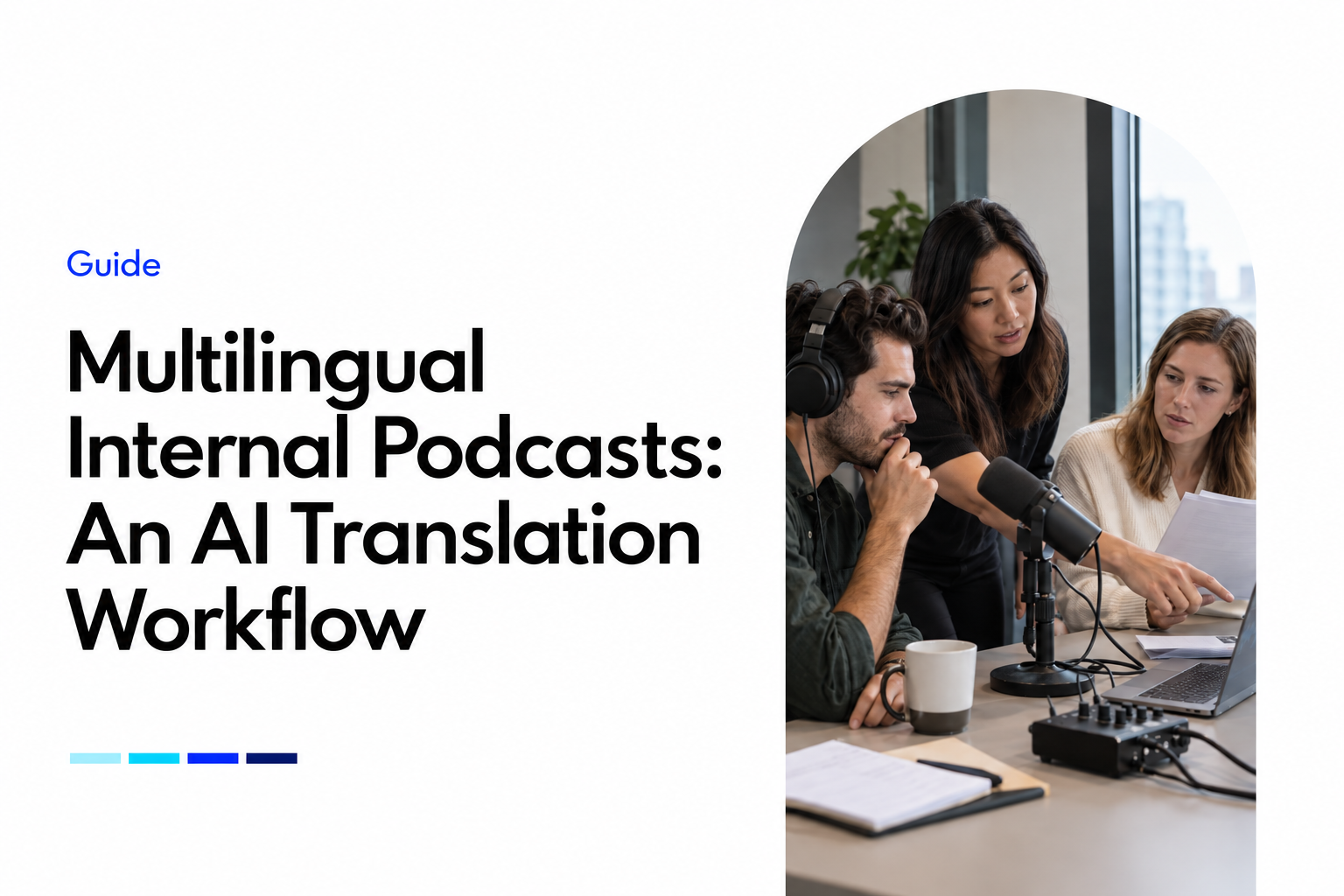
Choose a Format for Multilingual Internal Podcasts
Choose translated transcripts when employees primarily need readable information, human narration when delivery needs close editorial control, and AI dubbing when your team can support a repeatable review process. Treat these as complementary options, not a maturity ladder.
In a Digital Workplace Group practitioner discussion, Monique Zytnik and Nancy Goebel explore AI-enabled translation and employees choosing how they receive workplace information. Their discussion provides a useful starting point: design around language and format preferences, rather than translating everything into audio by default.
Use the following decision table as a planning framework. The effort assessments describe suggested workflow considerations, not vendor benchmarks.
| Approach | What Employees Receive | Recommended Use | Main Review Work | Update Considerations |
|---|---|---|---|---|
| Translated Transcript | Localized text accompanying the original episode | Reference material, searchable updates and an initial language pilot | Meaning, terminology, completeness and readability | Edit and approve text without generating a new audio performance |
| Human Narration | A translated script recorded by a local colleague or professional narrator | Sensitive leadership messages or content requiring carefully directed delivery | Translation accuracy, narrator briefing, pronunciation and final recording | Schedule pickups and check edits against the approved script |
| AI Dubbing | Synthetic translated speech, potentially resembling the original speaker | Recurring, lower-risk episodes with established language reviewers | Translation, voice permission, pronunciation, speaker assignment and final audio | Regenerate affected sections and review the complete replacement asset |
For a first pilot, consider one short onboarding episode, two target languages and a transcript for each version. Avoid making a restructuring announcement or safety instruction your first experiment. Use the internal company podcast playbook to establish the broader channel before adding localization.
Define the Workflow and Assign Owners
A podcast translation workflow is the controlled sequence from approved source audio to reviewed language versions and synchronized updates. Assign an accountable publisher, a source-content owner and a reviewer for each language before production starts.
For this workflow, use translation to mean transferring the message between languages and employee podcast localization to mean adapting that message for a specific audience. Localization can include local dates, familiar terminology, relevant policy references and appropriate forms of address.
Create a brief containing the episode objective, intended employee groups, source language, target locales, formats, publication deadline and sensitivity classification. Specify locales such as French for France or French for Canada where relevant, rather than assuming one language version fits every location.
- Communications producer: Coordinates files, reviewers, approvals and publishing.
- Content owner: Confirms facts, intended meaning and employee actions.
- Language reviewer: Checks translation, cultural fit and spoken delivery.
- HR or policy specialist: Approves locally relevant policy statements.
- IT and privacy contacts: Assess the proposed tools and data handling.
Set a stop rule: if a required reviewer is unavailable, do not release an unchecked translation. Arrange qualified backup coverage or communicate the language-version delay.
1. Lock the Source Before Translation
Translate only from an approved source transcript that matches the final edited recording. Resolve unclear wording, incorrect numbers and unexplained acronyms before creating downstream versions.
Ask speakers to use explicit dates, identify the relevant country or employee group, and distinguish proposals from confirmed decisions. Replace ambiguous references such as “next Friday” with a specific date in the approved recording where practical. Explain internal abbreviations on first use.
Compare the transcript with the audio rather than assuming automated transcription is correct. Microsoft Learn recommends comparing speech-recognition output with a human-generated transcript when assessing whether a base recognition model is sufficient.
- Finish the source edit, including corrections and removals.
- Check names, quantities, dates, speaker labels and negative statements.
- Have the content owner approve the recording and matching transcript.
- Assign an episode ID and source revision, such as ONB-014, revision 1.
Keep segment timestamps for later corrections. If the transcript reveals a material mistake in the recording, fix the source audio too. Do not leave source-language employees with one message while translated versions contain another.
2. Build a Terminology and Localization Pack
Give translators and reviewers a shared glossary before translation begins. Include approved terms, prohibited alternatives, pronunciation notes and instructions for words that must remain unchanged.
A useful glossary records the source term, its meaning, the approved target-language equivalent, the locale and the person responsible for it. Start with terms that could change employee actions: benefit names, job levels, leave categories, reporting channels and policy titles.
Glossary support is tool-specific. Microsoft Learn documents custom dictionaries that pair source phrases or sentences with preferred translations. It also notes that phrase dictionaries are case-sensitive and that dictionary support depends on the language pair. Test your actual terminology rather than assuming a glossary upload guarantees consistency.
Include these instructions in the localization pack:
- Keep product names and internal system labels unchanged unless an approved localized name exists.
- Expand unfamiliar acronyms and provide pronunciation guidance.
- Use unambiguous dates and identify time zones for deadlines.
- Do not convert currencies, invent local equivalents or alter eligibility rules.
- Flag unclear or apparently inapplicable statements for the content owner.
For example, a global onboarding episode should not silently replace a headquarters leave policy with a local policy. Create a separately approved local segment, or state clearly which population the original information covers.
3. Confirm Speaker Permission and Tool Approval
Obtain documented, specific permission before synthesizing a recognizable speaker’s voice. Treat recording, translation, human narration and synthetic voice reproduction as separate decisions in your production process.
Give speakers a plain-language explanation of the intended languages, audience, distribution channels and reuse period. Explain whether the output will use a different narrator, a generic synthetic voice or a voice resembling their own. Offer an alternative that does not require voice reproduction.
Record the agreed scope, who may generate audio, whether future episodes are included, and how a request to stop future use will be handled. This is a recommended production safeguard, not a substitute for legal review of the applicable employment, privacy and voice-rights requirements.
Before uploading internal recordings, ask IT, procurement and privacy colleagues to approve the complete processing chain:
- Which providers receive audio, transcripts and speaker information?
- Where are files processed and retained, and who can access them?
- Can uploaded content or derived voice assets be used for model training?
- What deletion controls, contractual protections and subprocessors apply?
- Can the team export approved assets without retaining an unnecessary voice model?
Do not assume that approval for podcast hosting also covers an external translation or dubbing provider. Review each service separately, using the secure podcast hosting guide to structure internal discussions.
4. Translate the Script Before Generating Audio
Use AI podcast translation to produce a draft, then approve the target-language script before narration or dubbing. Keep translation decisions separate from voice-generation decisions wherever the selected tools allow.
Provide the approved source, glossary, locale, audience and style instructions together. Request a faithful translation, not a summary. Ask the system to flag uncertainty rather than supplying a plausible interpretation.
Translate this approved employee podcast transcript into the specified locale. Preserve all facts, qualifications, numbers, dates, speaker identities and employee actions. Apply the attached glossary. Do not add promises or policy interpretations. List ambiguous passages separately for review.
Compare the draft against the source segment by segment. Pay particular attention to “may” versus “will,” “eligible” versus “entitled,” and statements containing “not.” Treat back-translation as a supplementary diagnostic, not the approval gate.
Check editing capabilities before selecting a dubbing service. ElevenLabs documentation, for example, describes supplying a source transcript and translations, but states that this capability is limited to enterprise workspaces. Verify the required workflow in the actual plan before procurement.
5. Review the Language and Finished Audio
Require a qualified native-language reviewer to approve both the translated script and the rendered audio. Add subject-matter review when the episode contains policy, benefits, safety or employment-related information.
Use two review passes. First, a bilingual reviewer compares meaning against the approved source. Second, a native-language listener checks the finished audio for clarity, pronunciation, pace and tone. One person may cover both roles when appropriately qualified, but neither pass should disappear.
- Meaning: Confirm facts, exceptions, obligations and calls to action.
- Local relevance: Check policy scope, terminology and employee references.
- Audio: Listen for missing words, wrong speakers, awkward pauses and mispronounced names.
- Consistency: Match the final audio to its transcript and summary.
- Approval: Record reviewer, date, revision and resolved issues.
For a conservative release policy, block publication for any error that changes an employee action, deadline, entitlement or policy interpretation. Document minor stylistic issues separately. If the reviewer cannot verify a passage, return it to the content owner rather than approving it because it sounds fluent.
Label synthetic delivery clearly. Suggested wording: “AI-translated and AI-narrated from the approved English episode. Reviewed by our German-language communications team.” Only use that statement when it accurately describes the process.
6. Publish Accessible, Clearly Labeled Versions
Publish each language version with an obvious language label, matching transcript and revision information. Keep the original available, but avoid making employees navigate through it to find their preferred language.
Include the topic, language and relevant locale in the title or description. Put the employee action and deadline in localized show notes. Test the complete journey on the devices and workplace channels your audience actually uses.
Transcripts should be part of the publishing checklist, not an afterthought. W3C explains that WCAG success criterion 1.2.1 requires an equivalent alternative for prerecorded audio-only content, with an exception for clearly labeled audio that is itself an alternative to text.
How Hypecast Fits the Workflow
- Record the source episode with remote guests in Hypecast Studio. Hypecast Studio for Desktop is available for Windows and Mac.
- Use HypecastAI support for transcripts and show notes, then have the source owner review the production materials.
- Complete translation, narration or dubbing through separately approved tools and reviewers. This workflow does not assume Hypecast provides translation or voice cloning.
- Publish approved episodes through Hypecast’s private, access-controlled employee podcast feeds.
- Distribute through supported workplace destinations such as Microsoft Teams, SharePoint and employee apps, with clearly labeled language versions.
For channel planning, consult the Microsoft Teams versus Spotify guide for internal podcasts. Keep audience permissions consistent across language editions.
7. Update Versions and Evaluate the Pilot
Treat every language edition as a dependent version of the approved source. When the source changes, identify affected assets and assign a reviewer before republishing.
Maintain a shared register containing episode ID, source revision, locale, transcript revision, audio revision, reviewer, publication location and status. Use explicit statuses such as draft, awaiting review, approved, published and superseded.
If a deadline changes, update more than the narration. Check transcripts, show notes, clips, intranet descriptions and scheduled Mail or Teams messages. Mark outdated editions clearly or withdraw them until corrected. For material changes, publish a localized correction notice rather than silently replacing the file.
Evaluate the pilot using production effort and employee understanding together. Track review time, correction categories, turnaround time and total approved cost per language. Ask participating employees what action the episode requested and whether the language felt clear and appropriate. Do not treat playback alone as proof of comprehension.
Expand multilingual employee communications only when the team can maintain terminology, review coverage and version control. A reliable two-language programme is a better starting point than ten unreviewed editions.
Ready to build a repeatable internal audio workflow? Explore Hypecast plans for recording, AI-supported production and private employee podcast distribution.