What Makes an Employee Spotlight Work in Audio?
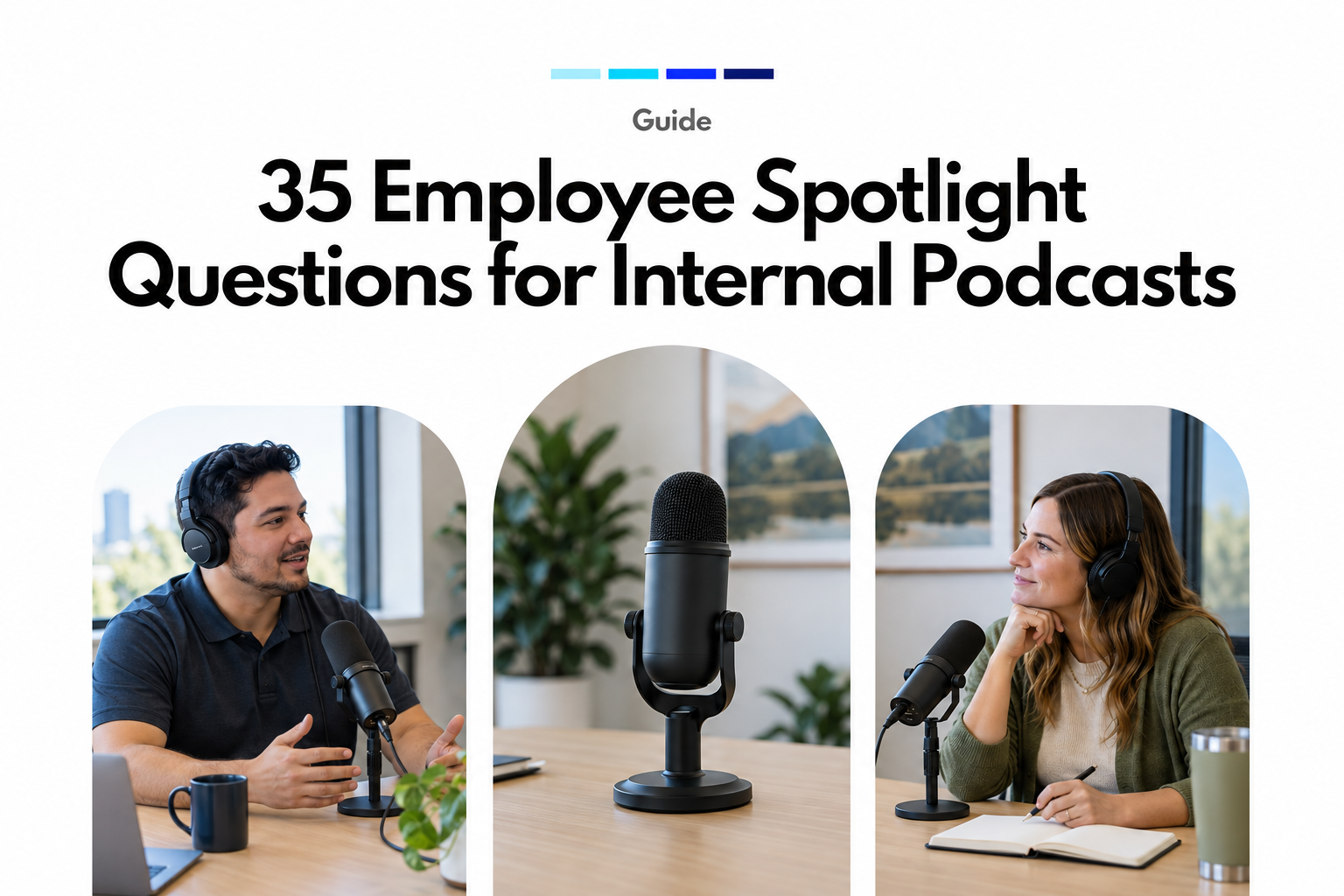
An employee spotlight podcast is a short internal interview about one colleague’s work and experiences. For this format, make everyday understanding the goal, rather than executive updates, recruitment messaging or a list of achievements.
The written and social spotlight is an established template-led format. Sprout Social provides templates for a social series framed around celebrating staff and employer branding. Adapt the repeatable structure, but change the audience and editorial purpose: help existing employees understand one another.
Build each episode around one useful question: what should coworkers understand about this person’s working day? A scheduling decision, an unfamiliar handover or a small improvement is enough. Do not require a dramatic career journey.
For audio, ask guests to explain acronyms and describe anything they would normally point to. Replace a tour of an organizational chart with a concrete example. For the wider channel strategy, see our internal podcast playbook for communications teams.
35 Employee Spotlight Questions by Role and Storytelling Purpose
Choose employee spotlight questions that fit the guest’s experience and the episode’s purpose. Use four or five main questions, then follow the most useful story instead of treating the interview as a questionnaire.
The groups below are editorial starting points, not fixed employee categories. A new colleague might also work on the frontline; a specialist might have a valuable story about collaboration.
All Employees: Make the Role Understandable
Use these questions to introduce unfamiliar work. Aim to explain the role through a task rather than a job description.
- What is one task from your last working day that helps explain what you do?
- Which part of your work would surprise someone who only knows your job title?
- How does a typical request reach you, and what happens next?
- What does a good working day look like in practical terms?
- What is one thing you wish colleagues understood before asking your team for help?
Follow-up prompts: “Take us through that task.” “What did you do first?” “What would a colleague notice when it is done well?”
New Joiners: Capture the First-Weeks Experience
Explore what made unfamiliar work easier to navigate. Keep the focus on useful discoveries, not an assessment of whether onboarding was successful.
- What was the first everyday task you learned to do here?
- Which unfamiliar term or process took a little time to understand?
- Can you describe a moment when a colleague helped you find your feet?
- What have you learned that would have been useful on your first day?
- What question would you encourage the next new starter to ask?
Follow-up prompts: “What made the explanation useful?” “Where did you find the answer?” “How would you explain it to someone joining tomorrow?”
Frontline and Shift-Based Employees: Explain Work Others Rarely See
Invite operational detail without requesting restricted information. Ask guests to avoid identifiable customer stories and descriptions that expose sensitive locations or procedures.
- What happens at the start of your shift that colleagues elsewhere might never see?
- Can you walk us through a handover that made your day easier?
- What small preparation makes the biggest difference to your work?
- When plans change during a shift, how do you work out what to do next?
- What should office-based colleagues understand about when and how your team receives information?
Follow-up prompts: “What information did you need?” “What could another team do differently?” “Can you describe that without naming a customer?”
Specialists and Support Teams: Make Hidden Work Visible
Use these employee interview questions for colleagues whose contributions are difficult to see from outside their team. Translate expertise into an understandable decision or example.
- What recurring problem does your team help colleagues solve?
- Can you describe a recent request that shows the thinking behind your work?
- What check do you carry out that others might not realize is necessary?
- Which trade-off comes up regularly in your role?
- What information helps you give someone a useful answer the first time?
Follow-up prompts: “What does that term mean?” “What were the options?” “Could you give a simplified example without confidential details?”
Cross-Functional Collaborators: Show How Work Moves Between Teams
Focus on the connection between people, not a project victory lap. Select a story that makes ownership, timing or expectations clearer.
- Tell us about a recent task that depended on another team.
- Where did your teams initially understand the task differently?
- What conversation helped you agree on the next step?
- What did a colleague in another role notice that you had missed?
- What would you repeat the next time those teams work together?
Follow-up prompts: “What changed after that conversation?” “Who needed which information?” “What could listeners borrow for their next handover?”
Experienced Colleagues and Internal Movers: Share Practical Learning
Draw out knowledge gained through experience without asking for a flawless success story. Let the guest choose an example they feel comfortable sharing.
- What task do you approach differently now than when you started?
- Which lesson from a previous role helps you in your current work?
- Can you describe a small adjustment that made a recurring task easier?
- What advice sounded abstract until you experienced it yourself?
- What would you show a colleague learning your role for the first time?
Follow-up prompts: “What prompted the change?” “What did you try next?” “When might that advice not apply?”
Any Employee: Close With Recognition and Connection
End with a specific contribution or practical invitation. Personal interests can remain optional; employees do not need to disclose their private lives to make a worthwhile episode.
- What small contribution from a colleague made your work easier recently?
- Which everyday part of your work gives you a sense of satisfaction?
- What skill are you currently practicing, and where do you use it?
- What would you like to learn about another team’s working day?
- What should listeners come to you or your team for after hearing this conversation?
Follow-up prompts: “What did that help you do?” “Would you like to name the colleague, subject to their agreement?” “What is the best internal route for that request?”
How to Ask Follow-Ups Without Making It Feel Scripted
Ask one question at a time, then follow the guest’s answer with a request for detail. Use your outline as a guide, not a script that prevents an unexpected but relevant story.
The Oral History Association recommends preparing an open-ended interview guide. The Pennsylvania Historical and Museum Commission likewise advises broad, open-ended questions rather than questions that invite short or yes-or-no answers.
For this format, use a simple sequence: moment, action, outcome, relevance. Establish the situation, ask what the employee did, explore what happened and finish with what coworkers can learn.
| If the Answer Is... | Try This Follow-Up | Editorial Purpose |
|---|---|---|
| Abstract: “We collaborate closely.” | “Tell me about the last time that happened.” | Find a specific scene. |
| Technical: “We reconciled the exceptions.” | “What does that mean for someone outside your team?” | Make the work understandable. |
| Too broad: “It was a busy month.” | “Which moment best captures it?” | Keep one narrative thread. |
| Overly polished: “Everything went smoothly.” | “What preparation helped it go smoothly?” | Reveal useful effort without demanding conflict. |
Leave a short pause before speaking. If an answer becomes sensitive, offer to stop or switch examples. Do not treat an employee spotlight as an investigation or push for a confession about mistakes.
A Reusable 10-Minute Employee Spotlight Template
Build the finished episode around one employee, one everyday story and one useful takeaway. The timings below are an editorial template, not a requirement to cut a guest off mid-answer.
| Time | Segment | Host Direction |
|---|---|---|
| 0:00–0:30 | Introduction | Name the guest, role and practical topic. |
| 0:30–2:00 | The Working Day | Ask question 1 or 11 to establish context. |
| 2:00–5:00 | One Specific Story | Choose one role-specific question; follow the moment, action and outcome. |
| 5:00–7:00 | The Connection | Explore a handover, helpful colleague or cross-team dependency. |
| 7:00–9:00 | The Useful Takeaway | Ask what coworkers could understand or do differently. |
| 9:00–10:00 | Recognition and Close | Thank the guest, summarize one lesson and give the agreed contact route. |
For example, a scheduling coordinator’s episode could follow one changed appointment: what information arrived, how they checked availability and what made the handover clear. Avoid turning the story into a department update.
Book a 20- to 25-minute recording slot as a practical starting point, including a sound check and pauses. Edit toward the outline rather than expecting an exact ten-minute live performance.
Copy this brief for each episode: guest; role; listener takeaway; everyday story; four main questions; optional follow-ups; excluded topics; intended audience; reviewer; publication date. Send the selected questions beforehand, but invite notes rather than scripted answers.
Prepare Guests and Protect the Intended Audience
Make participation voluntary and explain the recording, audience and review process before starting. Separate permission for the internal episode from any proposed public reuse.
The Oral History Association emphasizes informed participation, clear expectations and an opportunity for interviewees to review material before public release where possible. Adapt those principles into your internal editorial process; they do not replace your organization’s policies.
- Invite without pressure. Offer an easy way to decline, postpone or skip a question.
- Agree boundaries. Exclude confidential projects, identifiable customer details and topics the guest does not want to discuss.
- Explain use. State where the recording and transcript will appear and whether clips are planned.
- Set review expectations. Give the guest a clear review window for accuracy, confidentiality and comfort with the selected material.
- Check the audience. Confirm access settings and announcement channels before publishing.
Publish a reviewed transcript alongside the audio. W3C explains that prerecorded audio-only content needs an equivalent alternative under WCAG Success Criterion 1.2.1, subject to its stated exception. Check names, specialist terms and speaker labels before sharing.
Build a Repeatable Employee Storytelling Workflow
Give one editorial owner responsibility for guest selection, preparation, review and publication. Keep the structure consistent while rotating roles, locations, shifts and tenure.
Start with a three-episode pilot: a new joiner, a frontline colleague and a support specialist. Invite volunteers as well as nominations. Ask listeners what became clearer and which working day they want to hear about next, rather than treating listening figures alone as proof of engagement.
From Employee Story to Internal Episode With Hypecast
- Brief: Select one story and four questions using the template above.
- Record: Use Hypecast Studio to record with remote guests. Hypecast Studio for Desktop is available for Windows and Mac.
- Prepare: Use HypecastAI for transcript and show-note support, then have a human review the material.
- Approve: Complete the agreed employee and editorial checks before release.
- Distribute: Publish through private, access-controlled employee feeds and distribute into tools such as Microsoft Teams, SharePoint and employee apps.
Keep episode titles concrete: “How Maya Prepares a Shift Handover” tells employees more than “Meet Maya.” For production preparation, use the remote podcast recording checklist; for evaluation, see how to measure an internal podcast.
Ready to turn everyday employee experiences into a repeatable internal series? Explore Hypecast pricing.